Someone in a budget meeting is going to ask it, if they haven't already. If people get the answer from AI before they ever click, why are we still paying for a brand website?
It's a fair question, and the numbers behind it are real. When Pew Research tracked people's actual Google searches, the ones who saw an AI summary clicked through to a result 8% of the time, compared with 15% for the ones who didn't. This year, researchers at the University of Pennsylvania and Northeastern put people into Google's AI Mode and watched clicks to outside websites drop by almost 19 percentage points.
But the AI still has to get its answer from somewhere. If it isn't your site, it's a retailer listing, a cocktail blog or a Reddit thread. For most brands, that's an accuracy problem. For an alcohol brand, it's a compliance problem too, because AI doesn't run its answers past your legal team.
I asked Google three questions
Before writing this, I asked Google's AI the kind of questions people ask with a bottle in one hand and a phone in the other.
"How do I make a Paloma?" I got two complete recipes with measurements, how to salt the rim, and a YouTube tutorial. The sources were Love and Lemons, The Kitchn and Liquor.com.
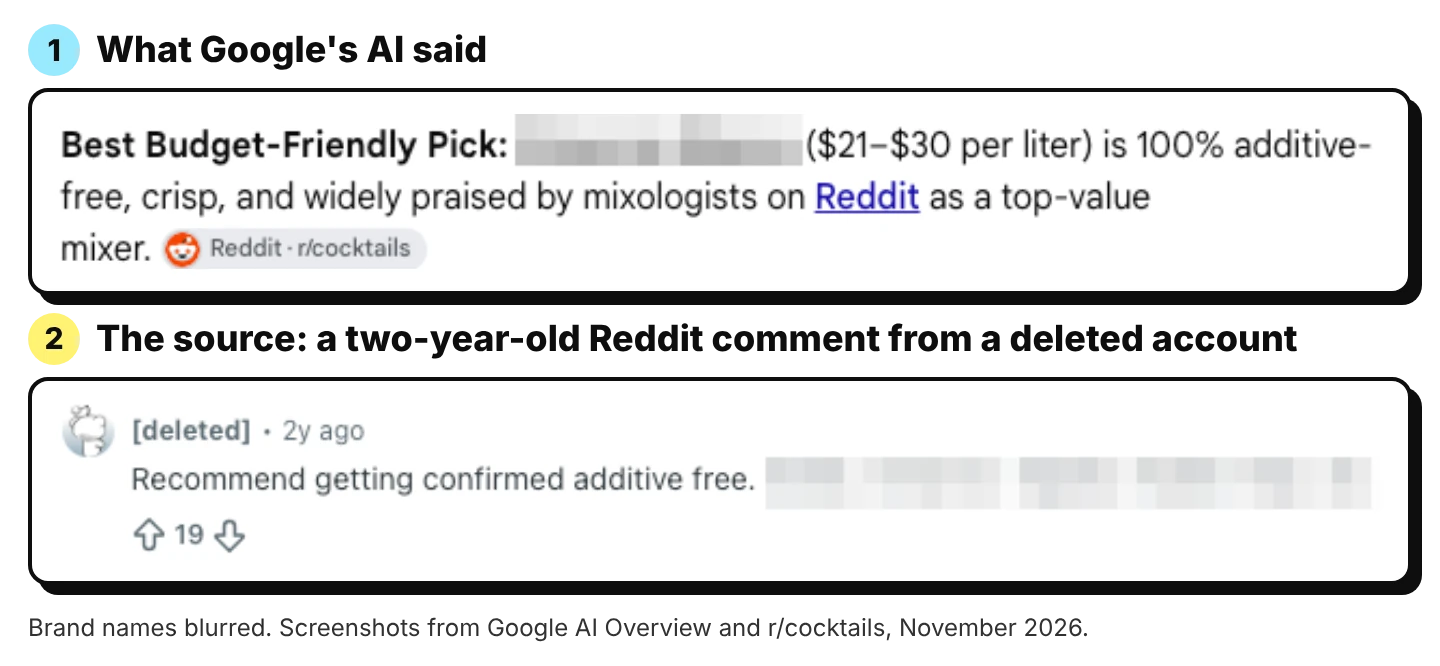
"Which tequila is best for a Paloma?" Bottles at three price points, with a Don Julio bottle as the picture. The budget pick was described as "100% additive-free" and "widely praised by mixologists on Reddit." The citation was a two-year-old r/cocktails thread, and the comment behind it came from a deleted account: "Recommend getting confirmed additive free," followed by a list of brands.
"What's the best rum for an Old Fashioned?" Four styles of rum, nine bottles and a recipe to finish.
The answers were good, and that's the problem, because nobody needed to click anything. None of them carried the responsible drinking message that every site in this category has to show. And the product claim came from a forum. It may well be accurate, but one anonymous comment became the description of a product, and the brand had no say in it.
Of the sources Google showed first, the only brand-side one was thebar.com, Diageo's own site, cited for the top-shelf picks. It's a small sign of the point of this article: when a brand's own content is there to quote, AI can use it.
The website's job has changed
For a long time, a brand website had one main job, which was to win the visit. You ranked, you got the click and you told your story once people arrived.
That job is getting smaller. The bigger one now is being the source AI relies on when it answers questions about your brand: what's in the bottle, how to drink it, where to buy it and what the brand stands for. You won't always get the click, but you can still be the reason the answer is right.
That's also the answer to the budget question. Cut the site and your brand stays in AI answers anyway, described by whoever wrote about it last.
Why most brand sites are hard for AI to read
As a digital agency, we've looked after brand sites for spirits and CPG companies for more than a decade. Lately we've been checking them for AI visibility as well as speed, accessibility and SEO, and the same problems keep coming up.
The facts are inside pictures
ABV, tasting notes and serves often live in images, carousels and hero videos. They look great to a person and are close to invisible to a machine.
The age gate hides everything
Every alcohol site needs one. But a gate that loads in place of the content, rather than on top of it, can stop crawlers reading the site at all. You can meet the requirement and still let search engines and AI read the page. It just has to be built that way on purpose.
Nothing tells the machine what it's looking at
Structured data, or schema markup, labels a page for machines: this is a product, this is a recipe, this is the company behind it. Most brand sites we look at have little or none. We recently added it across our own site, and it's a small job compared with almost anything else on this list.
Every market tells a slightly different story
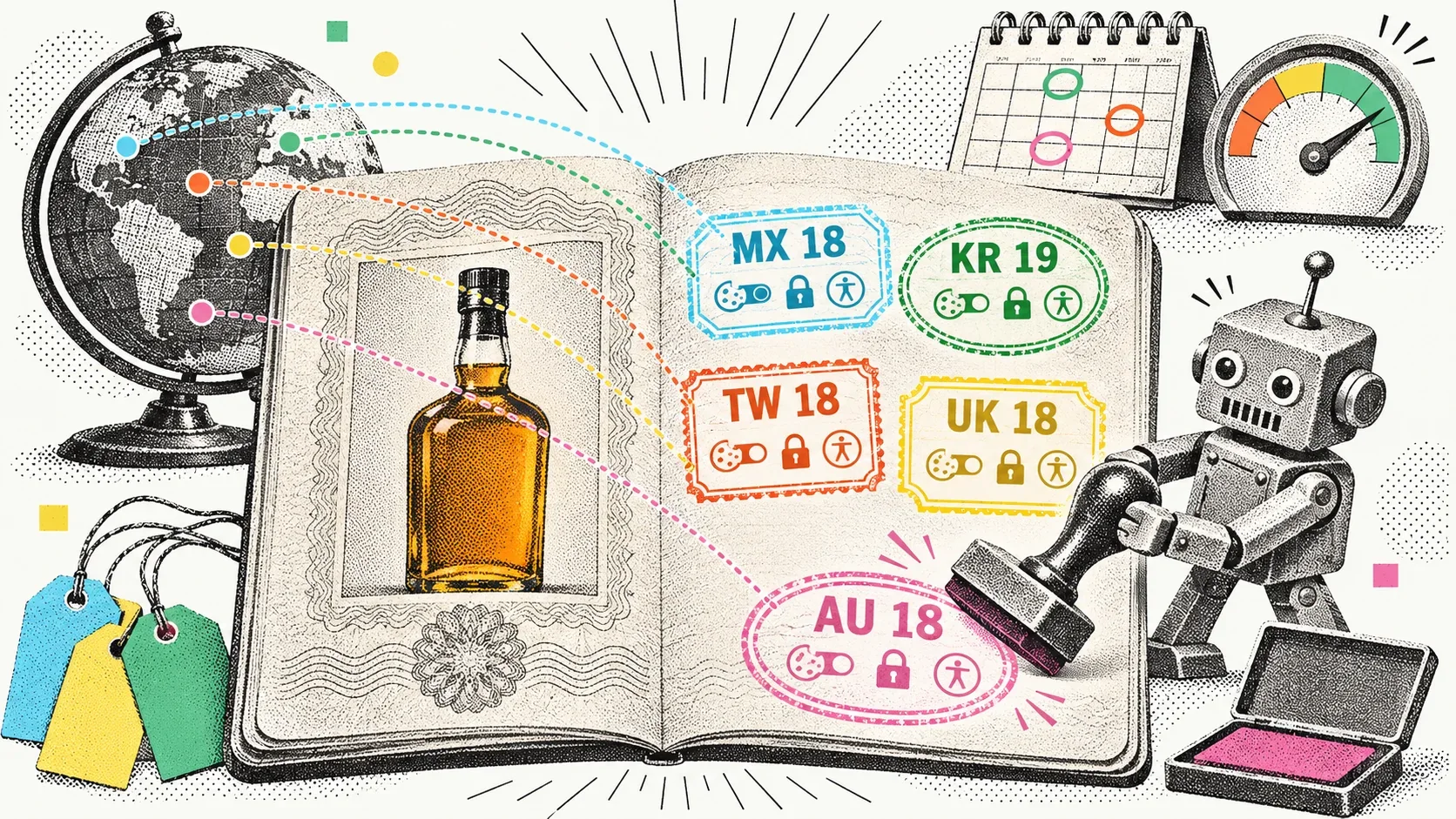
A global brand can have the same product described on a dozen market sites, written at different times by different teams. Some differences are legitimate, like a different ABV in a different market. When the pages don't make that clear, AI has to guess which version applies, and it often guesses wrong.
Nobody is measuring it
Most teams can tell you their organic traffic. Very few can tell you how often their brand shows up in AI answers, or what those answers say about it.
Not sure how your brand shows up in AI answers? We'll score it for you, free, in under a day. Tell us which brand.
What to fix first
Store the facts as text in the CMS. Product name, ABV, size, tasting notes, serves and markets should be fields in the content model. That way they're published as real text everywhere they appear, and the design can still make them look good. If you're moving platforms anyway, it's the right time to set this up, and a good migration leaves you with a content model built for it.
Add schema for what you actually have. Product, Recipe, Organization, FAQ and Breadcrumb cover most brand sites. For a spirits brand, the cocktail pages are often the content people ask about most, so mark those up first.
Rebuild the age gate so crawlers can see past it. The rule stays the same: visitors still confirm their age, but the page underneath is there for search engines and AI to read.
Give every fact one official home. Decide which page owns the description of each product and each serve. Then make the market sites match it, or label clearly where they differ and why.
Start measuring. ChatGPT and Perplexity show up as referrers in GA4, so that traffic is easy to separate. Google's AI answers are harder, because their clicks are counted with regular search traffic. So look beyond traffic and track which questions mention your brand and what the answers say.
What this looks like in practice
Our longest client relationship is with Diageo, where we've looked after brand sites for more than a decade. We recently ran a full audit of donjulio.com that scored the site on performance, accessibility, SEO, compliance and AI visibility, side by side. Putting AI visibility in the same scorecard matters because the fixes overlap. Facts stored as real text instead of images help screen readers, search engines and AI at the same time.
Measurement is the part brands tend to skip. When we migrated zacaparum.com within Diageo's platform, we implemented tracking to Diageo's measurement guidelines, and their measurement agency tested it before launch, so the team could see what was working from day one instead of months later. AI visibility needs the same discipline.
We've also built a tool for the part most teams can't see yet. It scores how visible a brand is in AI answers and how those answers talk about it, tracking sentiment and volume over time. We've tested it on real brands, including Don Julio.
Three questions to ask about your own site
- Ask AI five questions your customers ask about your product. Is your site cited in any of the answers?
- If you stripped out every image, could a machine still read your product facts?
- Do you know how often your brand appeared in AI answers this month, and what those answers said?
If you can say yes to all three, keep investing in the site. If you can't, keep the site anyway and fix it. It's still the one place where you decide how your brand is described.
Want to know what AI says about your brand?
Thorium Digital is a digital agency for multi-brand and regulated businesses, including spirits and CPG. We'll run your brand through our AI visibility scoring and audit the site behind it, so you can see what AI is saying about you and what to fix first. The scoring is free, and you'll have it in under a day. Tell us about your brand.